
Hope from Madrid

Pedro Sánchez and the Left’s Counterexample in a Right-Leaning World
Across much of the Western world, the political mood has shifted noticeably to the right. Nationalist rhetoric, tougher immigration policies, and growing skepticism toward multilateral institutions have reshaped political debates from Washington to several European capitals. In this climate, progressive leaders often appear defensive, struggling to present convincing alternatives. Yet in Spain, Prime Minister Pedro Sánchez has emerged as an unexpected counterexample—a leader who combines progressive ambition with economic credibility.
Since coming to power in 2018, Sánchez has positioned Spain as a rare case where social-democratic policies coexist with strong economic performance. At a time when many critics argue that the left cannot manage economic growth while expanding social protections, Spain’s recent trajectory challenges that assumption. The country has consistently outperformed many of its European peers in terms of economic growth, employment creation, and investment in new industries.
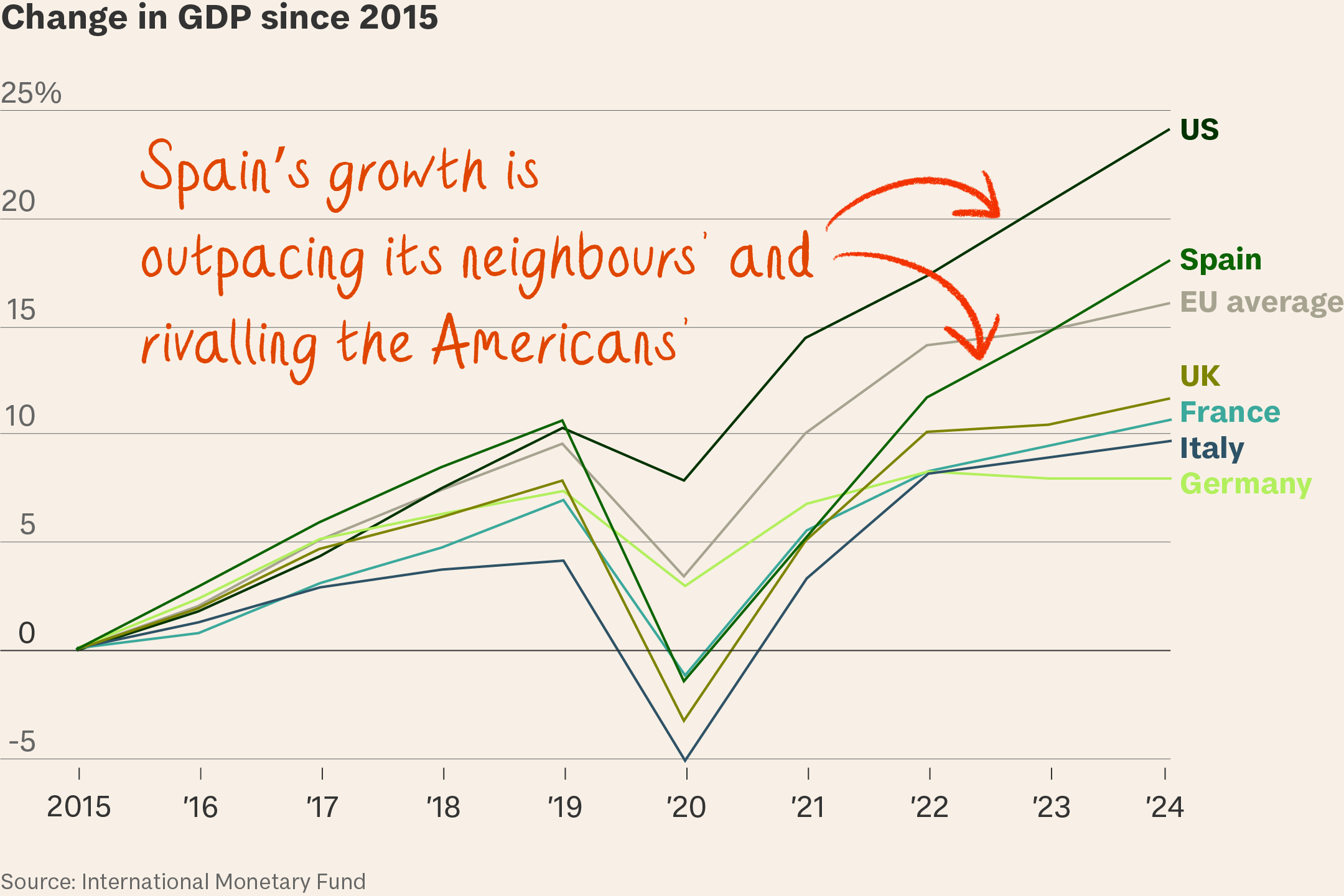
Spain’s economy has grown faster than most major economies in the eurozone in recent years, supported by a combination of tourism recovery, green investment, and the strategic use of European recovery funds. While several European economies have struggled with stagnation or slow growth, Spain has maintained relatively strong momentum. For Sánchez and his supporters, this performance provides a powerful argument: progressive policy agendas need not come at the expense of economic stability.
Part of this strategy has involved directing significant resources toward the green transition. Spain has invested heavily in renewable energy infrastructure, public transportation, and energy efficiency programs, positioning itself as one of Europe’s leaders in the shift toward a low-carbon economy. These initiatives not only aim to address climate change but also to create new industrial sectors and jobs—an approach that blends environmental goals with economic pragmatism.
Another defining feature of Sánchez’s approach is his stance on immigration. While many governments across Europe and North America have adopted increasingly restrictive policies, Spain has pursued a more pragmatic and humanitarian strategy. Sánchez’s government has argued that immigration can play a vital role in sustaining economic growth and addressing demographic challenges, particularly in sectors facing labor shortages.
This position stands in contrast to the tone of political debates in countries such as the United States, where immigration has often been framed primarily as a security issue. Sánchez has instead emphasized integration, labor participation, and demographic renewal—framing migration not only as a moral responsibility but also as an economic opportunity.
Beyond specific policies, Sánchez represents a broader political message. In an era marked by rising populism and polarization, he has consistently emphasized cooperation within the European Union and the importance of international partnerships. His government has supported deeper European integration, climate cooperation, and stronger international institutions, positioning Spain as a pro-European and outward-looking actor.
This approach offers a stark contrast to the inward-looking tendencies that have increasingly shaped global politics. At a moment when many leaders are retreating from international cooperation, Sánchez’s Spain has tried to demonstrate that multilateralism remains both relevant and beneficial.
Yet the story of Spain’s recent success is not without complications. Sánchez governs in a highly fragmented political landscape, where coalition politics and regional tensions create constant challenges. His administration relies on a delicate balance of parliamentary alliances, and political opposition remains intense. Critics also point out that Spain continues to face structural issues, including high public debt and housing shortages in major cities.
Moreover, some analysts argue that Spain’s economic strength is partly cyclical, benefiting from tourism recovery and the temporary boost of European recovery funds. Whether the current momentum can be sustained over the long term remains an open question.

Still, the broader political significance of Sánchez’s leadership should not be underestimated. At a time when progressive parties across Europe often struggle to articulate a compelling vision, Spain offers a rare example of a government attempting to combine social investment, economic growth, and international cooperation.
For many observers on the European left, this makes Sánchez’s Spain something more than a national success story. It represents a potential model—a reminder that progressive politics can still compete, govern, and deliver tangible results.
Spain may not hold all the answers for the future of the left, but for now, it offers something increasingly rare in contemporary politics: a glimmer of hope.
Comments ()