
Time for a Necessary Divorce – The End of the Transatlantic Illusion
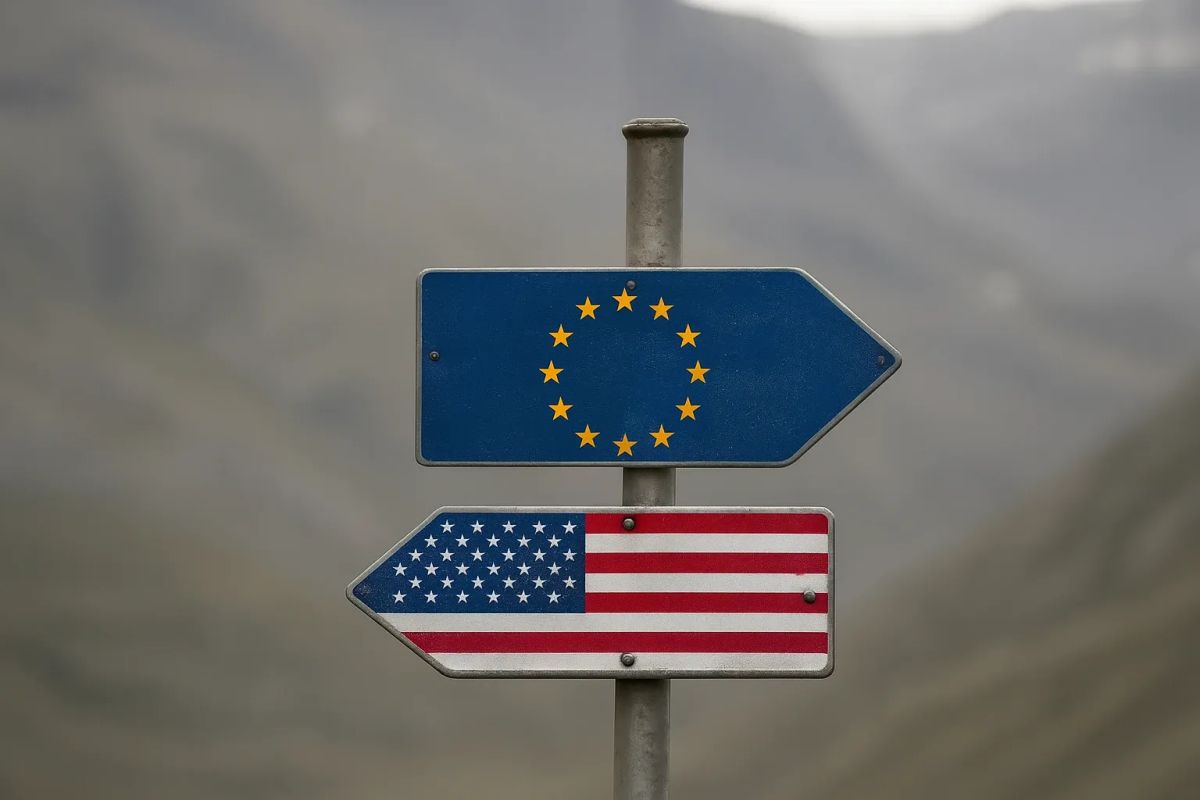
Since the end of the Second World War, Europe and the United States have been bound by a special relationship. It was more than a classic alliance: a marriage of convenience, founded on shared security interests, economic cooperation, and a commitment to liberal values. This partnership carried Europe through the Cold War and enabled stability and prosperity. But today it is becoming increasingly clear: this marriage is crumbling—not due to European will, but because the United States is increasingly turning away from it. Europe must draw consequences from this.
At the latest with the return of Donald Trump to the political center of the United States, it has become clear that Washington no longer regards the old transatlantic order as a given. Foreign policy is no longer understood as a joint project, but as an instrument for the maximum enforcement of national interests. Friend or foe, international law or military threats—all of this becomes secondary. In the redefined ultracapitalist policy, the focus is solely on economic or geopolitical gain.
Trade as a Demonstration of Power
The recent tariff and trade conflict between the United States and the European Union illustrates this development. Under the pretext of “unfair trade practices,” the U.S. threatened sweeping punitive tariffs and placed massive pressure on the EU. It was repeatedly claimed that Europe imposes broadly high tariffs on American products. This portrayal is misleading: in reality, the EU primarily protects its agriculture—for good reason, to preserve ecological standards, food security, and regional value creation.
At the same time, a structural imbalance becomes apparent. While the United States has developed enormous innovation momentum, particularly in the tech sector, Europe lags behind. This dependency makes Europe vulnerable to pressure. In addition, there is the growing political influence of American tech billionaires who openly support far-right and anti-EU forces in Europe. The goal is less about ideology than about instability—because a weakened Europe is easier to control.
Security Policy in the Wrong Century
Europe’s dependency is also painfully evident in security policy. NATO was for decades a guarantor of peace on the continent. But the security challenges of the 21st century are different. Automation, artificial intelligence, demographic change, and social upheavals will shape our societies more than traditional military threats.
Nevertheless, both the United States—with strategically calculated trade and energy maneuvers in the shadow of the Ukraine war—and Russia, for example through increased drone and airspace violations over the Baltic region and Denmark, are driving Europe into a new arms race. After a symbolic meeting at Donald Trump’s golf course in Scotland, the EU pledged to invest hundreds of billions of euros in defense in the coming years. A significant portion of these funds will not flow into European capacities, but directly to American defense corporations.
A severe blow—especially for the younger generation. Because this money is lacking where Europe’s future will be decided: in the restructuring of social systems, in education and research, in digitalization, and in ecological transformation. Instead of building strategic autonomy, Europe is cementing its dependency—and ultimately strengthening above all the U.S. military-industrial complex.
Geopolitics Without Scruples
American foreign policy increasingly shows how little regard is given to international norms when strategic interests are at stake. Venezuela is a warning example. Massive sanctions, open regime-change rhetoric, and the eventual abduction of Venezuelan President Nicolás Maduro without an international mandate reveal a clear pattern: the Western Hemisphere continues to be regarded as an American sphere of influence—a logic reminiscent of the old Monroe Doctrine, cynically rebranded by President Trump as the “DONroe Doctrine.” Statements by leading U.S. politicians, particularly Secretary of State Marco Rubio, referring to sovereign Latin American countries as “our backyard,” are more than diplomatic missteps—they reveal an imperial mindset.
Particularly alarming for the EU in this context are Trump’s repeated demands to take over Greenland. Greenland is an autonomous territory, belongs to Denmark, and thus to the EU community of values as well as NATO. The question is not whether these demands are realistic, but what they reveal: how seriously do the United States take their allies? And more importantly: would the EU today even be capable of politically or militarily defending such a territory?
Europe’s Strategic Void
All of these developments make one thing clear: we have long been living in a multipolar world order. The United States, China, Russia, and other actors act confidently according to their interests. Europe, on the other hand, remains in a state of strategic ambiguity. For too long, it has relied on the American security umbrella and failed to define its own geopolitical role. This is not about declaring the United States an adversary. But it is naive to believe that the transatlantic partnership can continue in its old form. A marriage of convenience that is sustained only on one side deserves honesty—and, if necessary, an orderly separation.
Europe must become more independent economically, technologically, and in terms of security policy. It must learn to think in terms of power without betraying its liberal values. And it must stop outsourcing responsibility out of convenience.
Europe must redefine and cement its place in the world—confidently, in solidarity, and realistically. Not against the United States, but no longer in dependence on them.
Sources:
3) https://www.reuters.com/world/americas/germany-urges-political-solution-venezuela-crisis-2026-01-03/?
Comments ()